

Why do two people with the same family history end up with such different health? One develops diabetes at 45 and loses part of her sight. Another, with the very same genes, stays well into old age.
On the last page, Where does disease come from?, we saw that illness appears when the person, a cause and the environment meet. This page asks a bigger question: what decides whether that meeting happens, how early, and how much harm it does?
The answer is a set of forces called the determinants of health.
What are the determinants of health?
They are all the factors that shape how healthy we are and how long we live. They fall into two big groups:
- What we are born with: our genes, age and sex.
- Everything we meet after birth: the way we live, the people around us, our home, school, work, income and healthcare, and the wider world of laws, culture, climate and business.
Picture them as layers, with you in the middle.
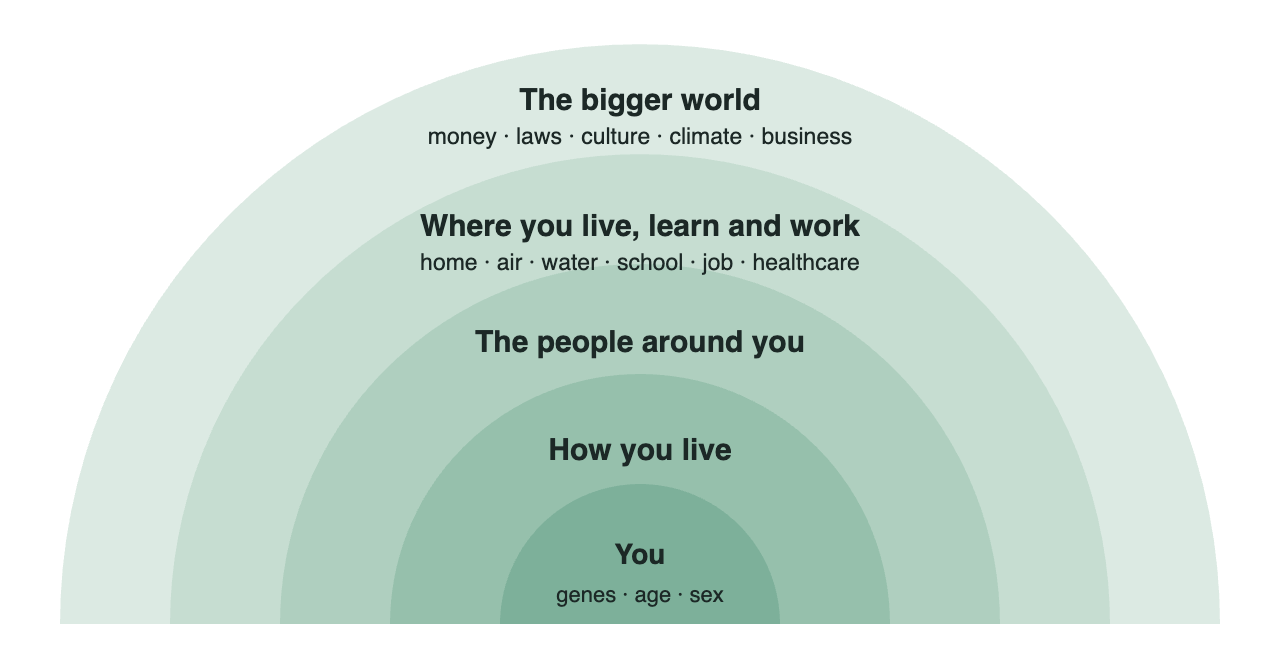
These layers do not act alone. They push on each other all through life. To see how, let’s follow two people.
A story: same genes, different lives
Asha and Maya are identical twins. They have the same genes and the same family risk: their father has type 2 diabetes. As babies, life separates them.
Childhood: the home
Asha grows up in a damp flat beside a busy road. By five, she wheezes every winter. It is asthma.
Maya grows up in a dry house near a park, and plays outside after school.
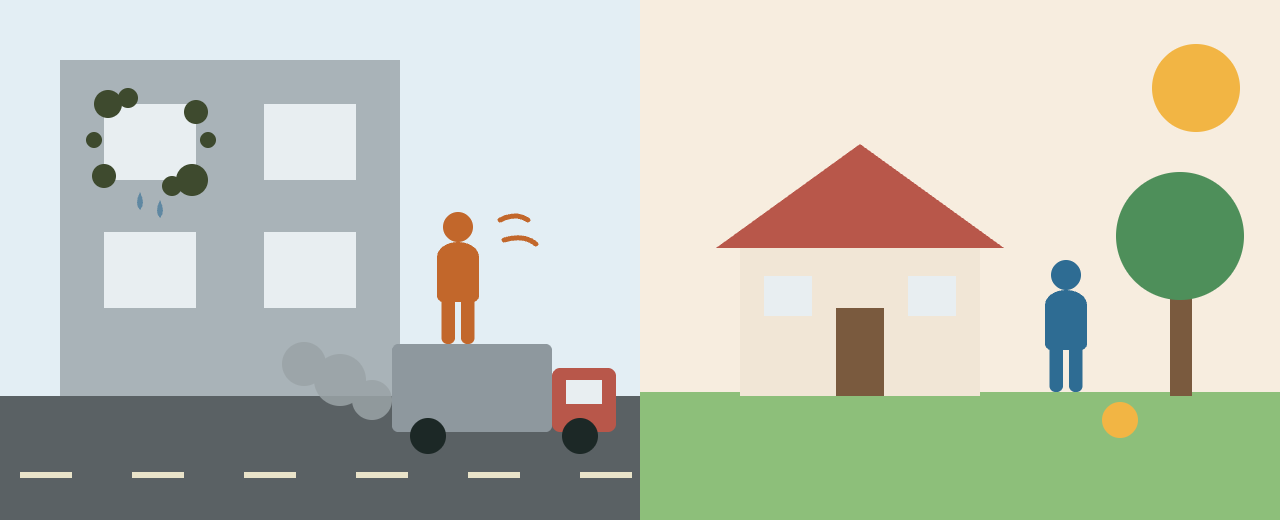
The determinant at work: living conditions. Mould and traffic fumes irritate young airways. People who live in damp, mouldy homes have up to a 75% higher risk of breathing problems and asthma.
Teenage years: school and friends
Asthma keeps Asha off school, and she leaves at 16. Her new friends smoke, so she does too.
Maya stays in school and goes on to university.
The determinant at work: education and the people around us. We learn our habits from family, friends, school and the media. Education also opens doors to better jobs, more income and a better understanding of health.
Working life: two kinds of risk
Asha works two jobs, often at night, about 60 hours a week. She eats whatever is quick and cheap, and smokes to cope.
Maya earns well but sits at a desk for ten hours, drives everywhere and eats rich restaurant meals. Slowly, her weight creeps up.
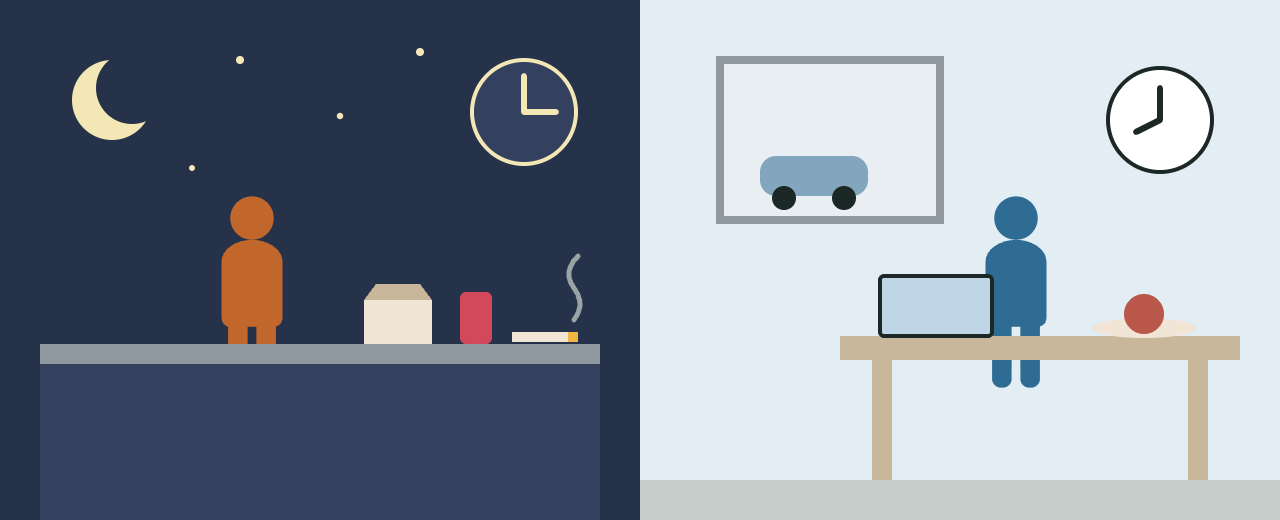
The determinant at work: work and income, in both directions. Long hours and low pay squeeze out sleep, cooking and exercise. Working 55 hours or more a week is linked to a higher risk of heart disease and stroke, and it leaves less time for the sleep, movement and healthy meals that protect against other long-term conditions. Comfort carries its own risks too: sitting all day and eating rich food push up weight and blood sugar, and people who are not active enough have a 20–30% higher risk of dying early.
Middle age: connection and care
Asha moves cities for work, knows nobody, and cannot afford an unpaid day off to see a doctor.
Maya walks with friends at weekends, and her employer offers a yearly health check.
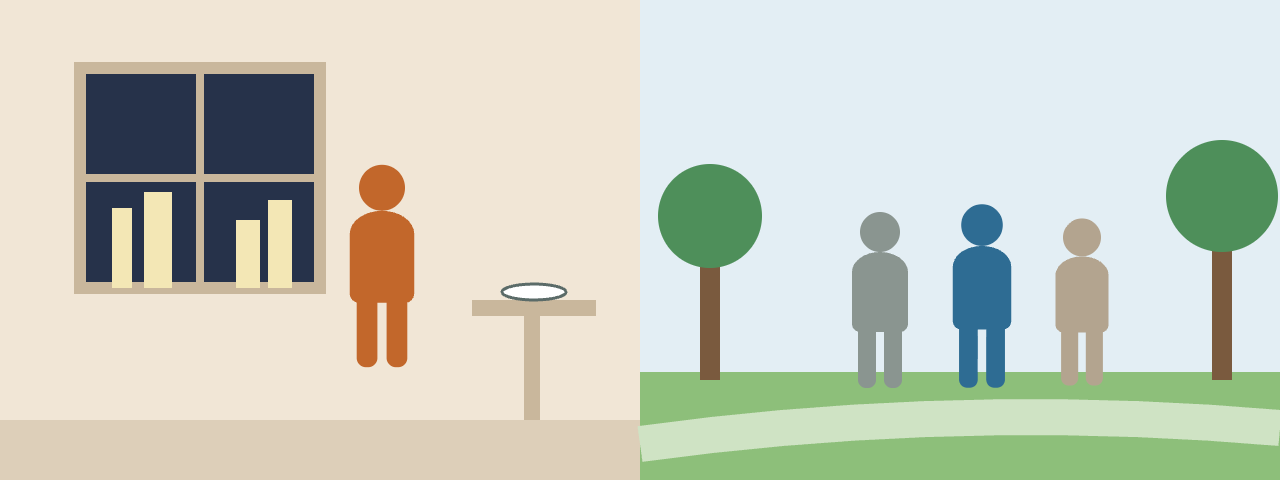
The determinant at work: social connection and health services. Loneliness affects about 1 in 6 people worldwide and is linked to over 870,000 deaths a year. Check-ups matter because more than 4 in 10 people with diabetes do not know they have it.
Age 50: the results
Both sisters develop high blood sugar. Their genes made that likely. But their lives decided the rest.
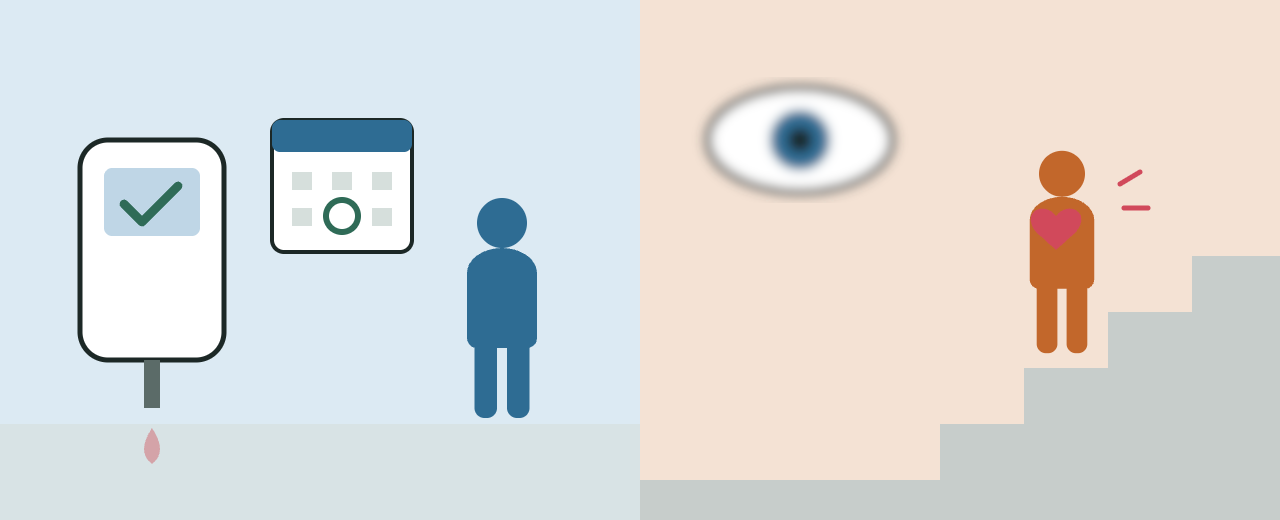
Maya’s is found early at her check-up. She changes her diet, starts walking and takes her medicine. She stays well.
Asha’s is found only when her eyesight blurs. Years of unnoticed high sugar have damaged the blood vessels in her eyes, and climbing stairs now brings chest pain.
Same genes. Same tendency. Very different outcomes.
Three things the story teaches us
1. Genes set the starting line, not the finish line.
Roughly half of the differences between people in many traits run in families. But in nearly half a million adults, the way people lived and the world around them explained many times more of the risk of dying early than their genes did.
2. Determinants work in chains.
Illness rarely has one cause. It usually travels down a chain:
- Life circumstances (low pay, long hours, a damp home) →
- Risk factors (smoking, poor diet, inactivity, stress) →
- Changes in the body (weight gain, high blood pressure, high blood sugar) →
- Disease (diabetes, heart attack, stroke)
Determinants are the “causes of the causes”. Risk factors are the specific, measurable things they lead to, which sit closer to the disease itself. Worldwide, nearly half of all illness and early death is linked to risk factors that can be changed.
3. Risks pile up, and one risk opens the door to the next.
Risk factors rarely stay alone. Extra body weight, too little movement, smoking and too much salt raise the chance of high blood pressure and type 2 diabetes. Those conditions then strain the heart, brain, kidneys and eyes. When several risks meet in one person, the danger can multiply rather than simply add up: smoking on top of high blood pressure and high cholesterol is far riskier than any one of them alone.
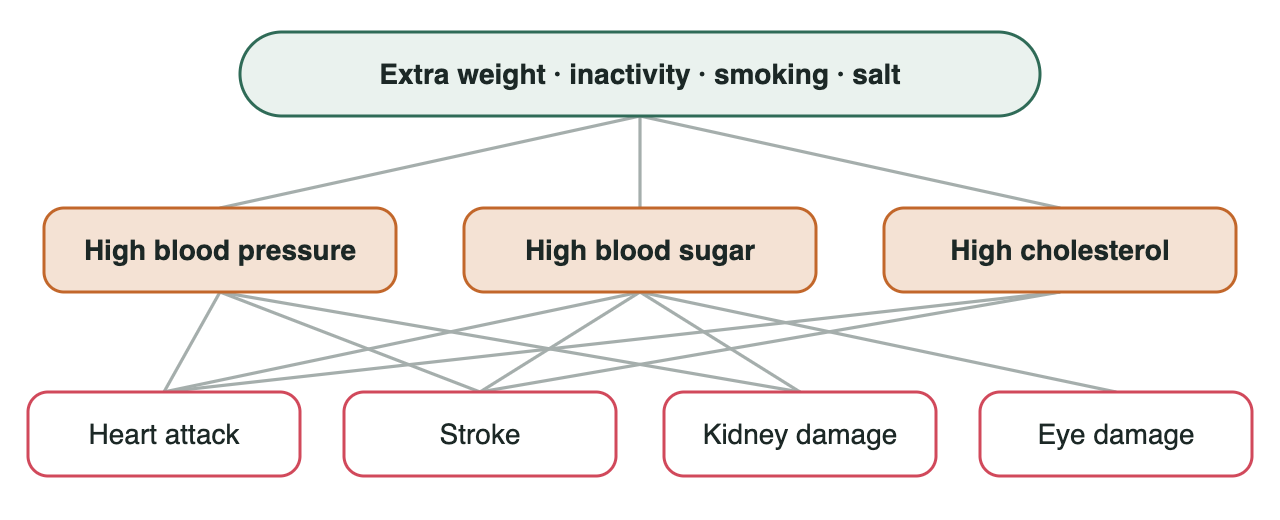
So one condition rarely comes alone. Living with two or more long-term conditions at once is called multimorbidity. In a study of 1.75 million people, almost 1 in 4 already had two or more conditions, and people in the poorest areas developed them 10 to 15 years earlier than those in the richest. By 50, Asha is living with asthma, diabetes and chest pain at the same time.
These risks build over a whole lifetime: a damp childhood, then smoking, then stress. That is why, within one country, people in the poorest areas can live decades fewer years in good health. In England, the gap is about 19 to 20 years.
Doctors matter, especially when you are ill. But rough expert estimates suggest medical care explains only one-tenth to one-fifth of a population’s health. Most health is made outside the clinic.
Asha’s story is not over

At 50, Asha acts. She stops smoking, and within a year her risk of heart disease is about half that of a smoker. She walks daily, joins a community group and takes her medicines. Even people with high-risk genes can gain about five extra years of life by living healthily from middle age.
What this means for you
Not every determinant is in your hands, but many are:
- What you control: food, movement, sleep, smoking, alcohol.
- What you can influence: friendships, learning, regular health checks, your family’s habits.
- What we must change together: clean air, safe homes, fair working hours, good schools.
Your genes load the dice. Your life, your people and your world decide how they roll.
What’s next?
If these forces shape our health, how do they actually make us ill? Find out in How do determinants make us ill?
Looking back: Where does disease come from?
Sources
- Park K. Park’s Textbook of Preventive and Social Medicine, 23rd ed. Banarsidas Bhanot; 2015. Ch. 1: Determinants of health; Risk factors.
- Dahlgren G, Whitehead M. The Dahlgren–Whitehead model of health determinants: 30 years on and still chasing rainbows. Public Health 2021;199:20–24.
- WHO Regional Office for Europe. WHO guidelines for indoor air quality: dampness and mould. 2009.
- Pega F, et al. (WHO/ILO). Burdens of ischemic heart disease and stroke attributable to exposure to long working hours. Environment International 2021;154:106595. WHO summary.
- World Health Organization. Physical activity (fact sheet).
- World Health Organization. From loneliness to social connection: report of the WHO Commission on Social Connection. 2025.
- International Diabetes Federation. IDF Diabetes Atlas, 11th ed. 2025.
- World Health Organization. Diabetes (fact sheet).
- Polderman TJC, et al. Meta-analysis of the heritability of human traits based on fifty years of twin studies. Nature Genetics 2015;47:702–709.
- Argentieri MA, et al. Integrating the environmental and genetic architectures of aging and mortality. Nature Medicine 2025. University of Oxford summary.
- Link BG, Phelan J. Social conditions as fundamental causes of disease. J Health Soc Behav 1995;Spec No:80–94.
- WHO Commission on Social Determinants of Health. Closing the gap in a generation. 2008.
- GBD 2023 Diseases and Injuries and Risk Factors Collaborators. Burden of 375 diseases and injuries, risk-attributable burden of 88 risk factors, and healthy life expectancy, 1990–2023. The Lancet 2025;406:1873–1922.
- World Health Organization. Hypertension (fact sheet).
- World Health Organization. Obesity and overweight (fact sheet).
- Barnett K, Mercer SW, Norbury M, Watt G, Wyke S, Guthrie B. Epidemiology of multimorbidity and implications for health care, research, and medical education: a cross-sectional study. The Lancet 2012;380:37–43.
- World Health Organization. World report on social determinants of health equity. 2025.
- Office for National Statistics. Healthy life expectancy by national deprivation deciles, England: 2020 to 2022.
- Schroeder SA. We can do better: improving the health of the American people. N Engl J Med 2007;357:1221–1228.
- County Health Rankings & Roadmaps. Is the County Health Rankings model right or wrong?
- World Health Organization. Tobacco: health benefits of smoking cessation.
- Bian Z, et al. Genetic predisposition, modifiable lifestyles, and their joint effects on human lifespan. BMJ Evidence-Based Medicine 2024;29(4):255–263.