
Written by Dr Nandan Jha, MBBS, MRCEM, MRCGP · Last reviewed November 2026 · Next review November 2027
You feel perfectly well. Then you are told to take a tablet every day, possibly for years. You read the leaflet, see a long list of side effects, and wonder: is this safe for me?
No medicine in the world is completely free of side effects. But in my day-to-day practice, very few of the patients I explain side effects to come back with one and ask to change their medicine. Most people tolerate most medicines well, and many have no side effects at all.
For full details, always read the leaflet that comes with your medicine. Here, I am only discussing a few of the common things.
At a glance
- Blood pressure medicine protects you even when you feel well.
- Most people tolerate their medicine well.
- Some medicines need a blood test soon after you start.
- If you cannot stay hydrated and keep feeling unwell with vomiting or diarrhoea, speak to your doctor.
- Do not stop your medicine suddenly. Speak to your doctor first.
Jump to: Types of medicine · Blood tests · If you are unwell · Side effects · Stopping · Urgent help
Why take a tablet if you feel well?
High blood pressure can quietly cause damage long before you feel anything. Medicine lowers the pressure and protects your heart, brain, kidneys and eyes. Healthy habits help too, and if they work well, your doctor may be able to reduce your medicine.
What are the main types of medicine?
1. ACE inhibitors (such as ramipril)
- What they do: relax and widen your blood vessels.
- Your kidneys: they can help protect the kidneys in people with diabetes or kidney disease, especially if there is protein in the urine. But they can also affect kidney function, so this depends on how well your kidneys are working. Your blood tests will show this.
- Common side effects: dry cough, dizziness, headache.
- Rare but serious: swelling of the lips, face or throat. This can happen at any time, even years after starting.
- Not usually used if: you are pregnant, planning pregnancy or breastfeeding. Avoid it if you have had this type of swelling before.
2. ARBs (such as losartan)
- What they do: work in a similar way to ACE inhibitors, and are less likely to cause a cough. They can also help protect the kidneys. An ACE inhibitor and an ARB should not be taken together.
- Common side effects: dizziness, headache, high potassium.
- Not usually used if: you are pregnant, planning pregnancy or breastfeeding.
3. Calcium channel blockers (such as amlodipine)
- What they do: relax your blood vessels.
- Common side effects: swollen ankles, flushing, headache, palpitations.
- Avoid if: you have unstable angina or severe narrowing of the aortic heart valve.
4. Thiazide-like diuretics (such as indapamide)
- What they do: these “water tablets” help your kidneys remove salt and water, and relax your blood vessels.
- Common side effects: low sodium or potassium, dizziness on standing, raised uric acid.
- Avoid if: you have Addison’s disease, high calcium, low sodium, gout caused by high uric acid, or a sulfonamide allergy.
5. Spironolactone
- What it does: another water tablet, which may be added if three medicines have not been enough.
- Possible side effects: high potassium, kidney problems, sore or larger breasts.
- Avoid if: you have high potassium or Addison’s disease.
6. Alpha-blockers (such as doxazosin)
- What they do: relax your blood vessels.
- Common side effects: dizziness, headache, swelling.
- Avoid if: you have had a drop in blood pressure on standing.
7. Beta-blockers (such as bisoprolol)
- What they do: slow your heart and reduce how hard it pumps.
- Common side effects: slow heartbeat, cold hands and feet, tiredness, sleep problems.
- Avoid if: you have asthma, a very slow heartbeat or some types of heart block. If you have diabetes, they can hide the warning signs of low blood sugar.
Why might I need a blood test?
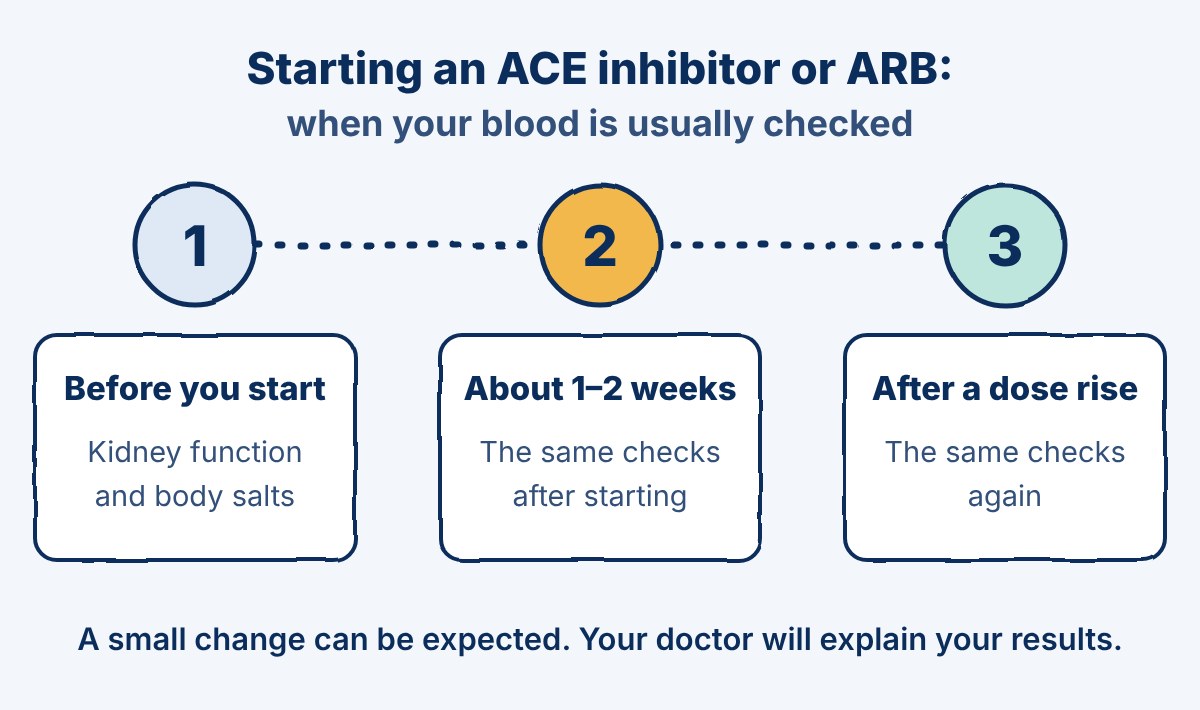
ACE inhibitors and ARBs can affect your kidneys and the salts in your blood, such as potassium. Your doctor will usually check these before you start, about 1 to 2 weeks after starting, and after each dose increase.
A small change can be expected, and your dose may not need to change. Water tablets and spironolactone may also need blood tests.
What if I get vomiting, diarrhoea or dehydration?
Some medicines, such as ACE inhibitors, ARBs and water tablets (diuretics), can affect your kidney function test. Being dehydrated can make this worse.
If you are unable to stay hydrated and you keep feeling unwell with vomiting or diarrhoea, speak to your doctor. They may advise you to stop the medicine until you are eating and drinking normally.
What should I do if I get a side effect?
Many side effects ease within a few weeks. If yours does not, or it worries you, speak to your doctor or pharmacist. Write down when it started and how long it lasts.
| What you may notice | What may help |
|---|---|
| Dry cough on an ACE inhibitor | Ask about changing to an ARB |
| Swollen ankles on a calcium channel blocker | Ask about changing your medicine |
| Dizziness when you stand up | Get up slowly and sit down if dizzy. Ask for a lying and standing blood pressure check |
| Cold hands and feet on a beta-blocker | Speak to your doctor. Do not stop it suddenly |
Sometimes, simply expecting a side effect can make us notice symptoms more. This is called the nocebo effect. Your symptoms are still real, so please mention them.
Check before it goes on your record. A symptom that starts after a new tablet is not always caused by that tablet. Before it is recorded as a side effect, intolerance or allergy, your doctor should look for other possible causes. Once it is on your record, a useful medicine may not be offered to you again.
If your symptoms are mild, talk through the benefits and problems with your doctor. If the benefit is greater and you can manage the side effect, you may decide together to carry on.
You can also report side effects through the Yellow Card scheme. Tell your doctor or pharmacist before taking herbal remedies or supplements, as they can interact with your medicine.
Why should I not stop suddenly?
Stopping can make your blood pressure rise, and with some medicines, such as beta-blockers and clonidine, stopping suddenly can be dangerous. Speak to your doctor first.
When should I get urgent help?
Call 999 if your lips, mouth, throat or tongue suddenly swell, or you have trouble breathing or swallowing.
Speak to a doctor or call NHS 111 now if you take an ACE inhibitor and have swollen ankles, blood in your urine or are not passing urine.
Taking a tablet when you feel well is not easy, and it is fine to have doubts. No medicine is free of side effects, but most people tolerate theirs well. Bring your worries to your doctor, and decide together.
Coming next: Cannot tolerate your blood pressure tablets? Your options
Illustrations on this page were made with AI.
References
- NICE. Hypertension in adults (NG136). Updated February 2026.
- NICE. Chronic kidney disease (NG203).
- BNF. Ramipril, losartan, amlodipine, indapamide, spironolactone, doxazosin and bisoprolol monographs.
- BNF. Drugs affecting the renin-angiotensin system.
- Jones DW, et al. 2025 AHA/ACC high blood pressure guideline. Circulation 2025;152:e114.
- McEvoy JW, et al. 2024 ESC hypertension guidelines. Eur Heart J 2024;45:3912–4018.
- British Heart Foundation. Blood pressure medicine side effects.
- NHS. How and when to take ramipril.
- NHS. Side effects of ramipril.
- Kidney Care UK. Medicines for high blood pressure.
- American Heart Association. Types of blood pressure medications.