Written by Dr Nandan Jha, MBBS, MRCEM, MRCGP · Last reviewed November 2026 · Next review November 2027
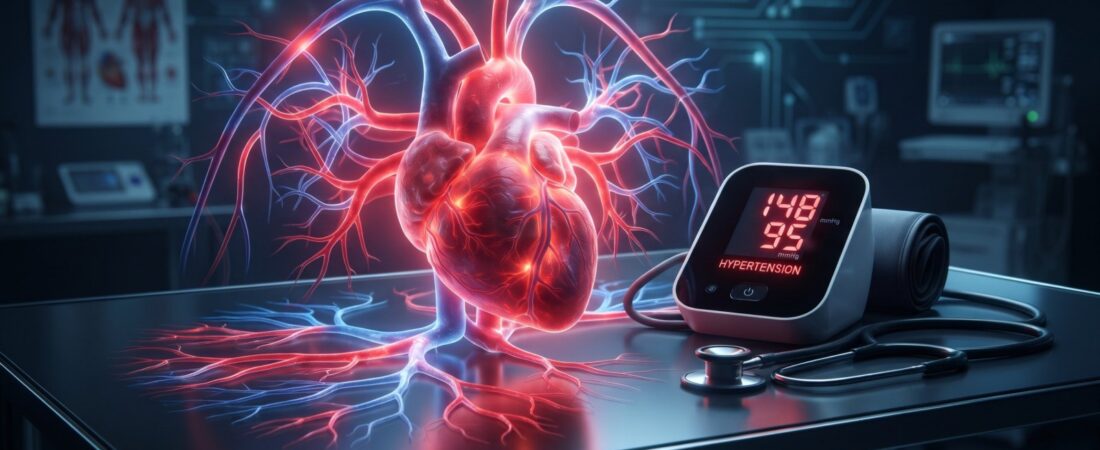
Every hour, more than 1,000 people die from strokes and heart attacks caused by high blood pressure. Most of these deaths could be prevented.
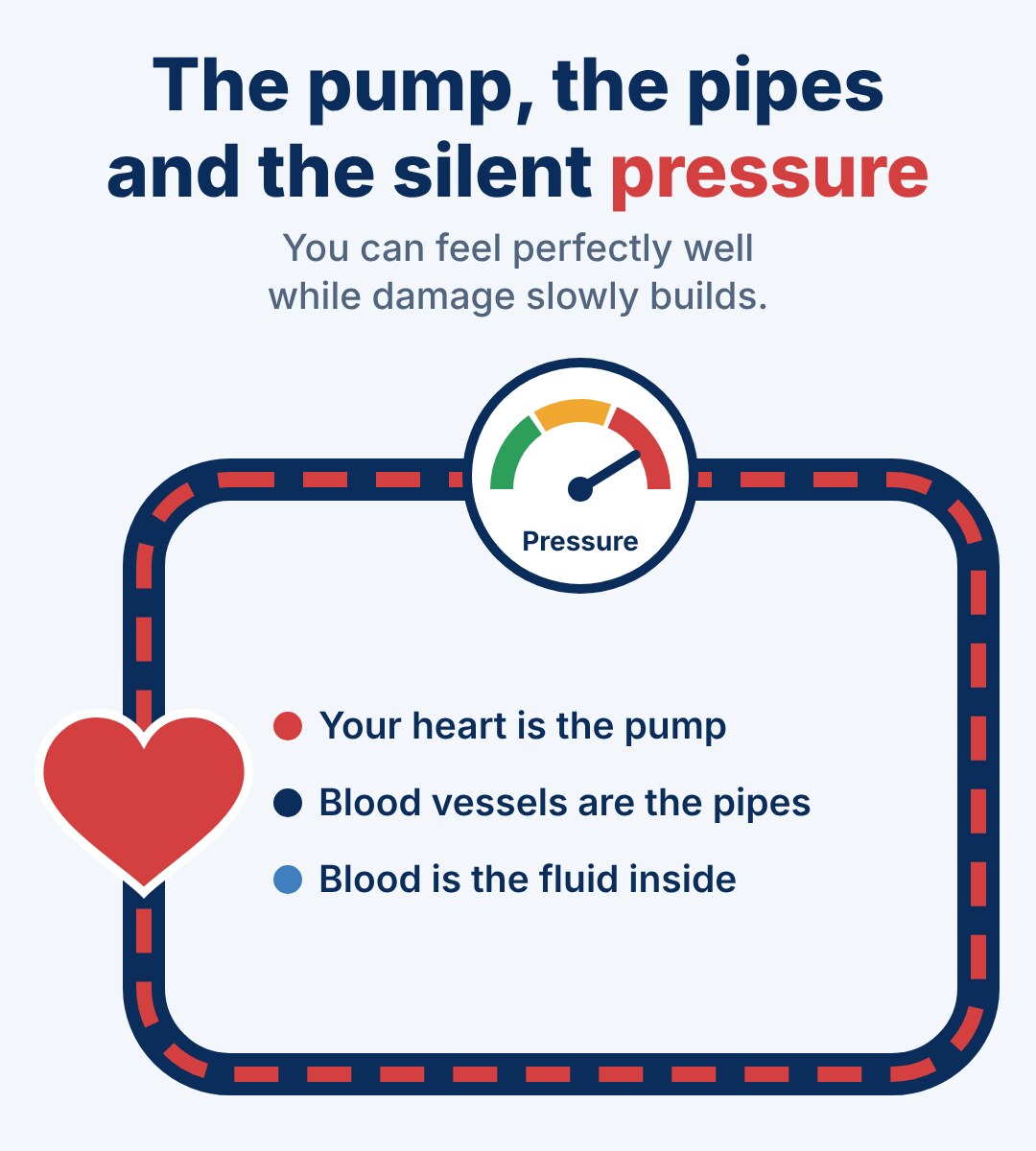
The frightening part is how quietly it happens. Imagine a water system running through your home. A pump pushes water through the pipes all day, and while it works well, you hardly think about it. Your body works in a similar way. Your heart is the pump, your blood vessels are the pipes, and your blood is the fluid inside them. When the pressure in those pipes stays too high, you can feel perfectly well while damage slowly builds. The good news is that the pressure is simple to check, and there is plenty we can do to bring it down.
At a glance
- High blood pressure usually causes no symptoms.
- It usually means 140/90 or above in a clinic, with a home average of 135/85 or above.
- One high reading does not confirm it.
- Untreated, it can damage your heart, brain, kidneys and eyes.
- Healthy habits help prevent it and work alongside treatment.
Jump to: What your numbers mean · When it is urgent · What you can do · Treatment · Questions
What is high blood pressure?
High blood pressure, or hypertension, means the pressure in your blood vessels stays too high. It is very common. An estimated 1.4 billion adults aged 30 to 79 had it in 2024, or one in three people in that age group. About 600 million did not know they had it, and only about 320 million had it under control.
What do the two numbers mean?
Blood pressure is measured with two numbers, such as 130/80.
The top number is systolic pressure. This is the pressure when your heart squeezes and pushes blood out. It often rises as we age because large arteries stiffen. A high top number on its own is the most common type in older people. More than 8 in 10 untreated people over 60 with high blood pressure have this pattern. With age, the top number becomes the main driver of heart and stroke risk.
The bottom number is diastolic pressure. This is the pressure when your heart rests between beats. It tends to rise until about middle age, then levels off or falls. A high bottom number on its own is more common in younger adults, particularly those with obesity. In people under 50, the bottom number is an especially important sign of heart risk.
Either number can be high, or both. Each one matters.
Types of high blood pressure
Primary hypertension is the most common type. No single cause is found.
Secondary hypertension has an identifiable cause and affects about 1 in 10 people. Causes include kidney disease, hormone problems, narrowed kidney arteries, sleep apnoea and some medicines, such as the combined contraceptive pill. It is more common in younger people.
How does the pressure rise?
Blood pressure depends on how much blood the pump pushes out and how much the small pipes resist that flow. In most people with long-term high blood pressure, the pump pushes a normal amount, but the small pipes resist too much.
Several things seem to work together:
- Small arteries: Muscle in their walls tightens. If this continues, the walls may thicken and keep the pressure high.
- Kidneys: They balance salt and water, and some people may inherit a problem with handling salt.
- Hormones: One hormone system narrows the arteries and makes the body hold on to salt and water.
- Nerves: They help control blood pressure and adjust it during stress and exercise.
- Family: High blood pressure is about twice as common in people with one or two affected parents. Families share genes, but also eating habits.
- Daily life: Salt, excess weight, inactivity, alcohol, poor sleep, stress and air pollution all play a part.
Your risk also rises with age, and with diabetes or kidney disease.
What are the symptoms?
Most people have no symptoms at all. That is why it is often found only during a routine check.
Very high blood pressure can cause severe headaches, chest pain, dizziness, breathlessness, nausea, vomiting, blurred vision, confusion, buzzing in the ears, nosebleeds or an irregular heartbeat.
Why feeling well is not enough
Over time, the extra pressure can harm:
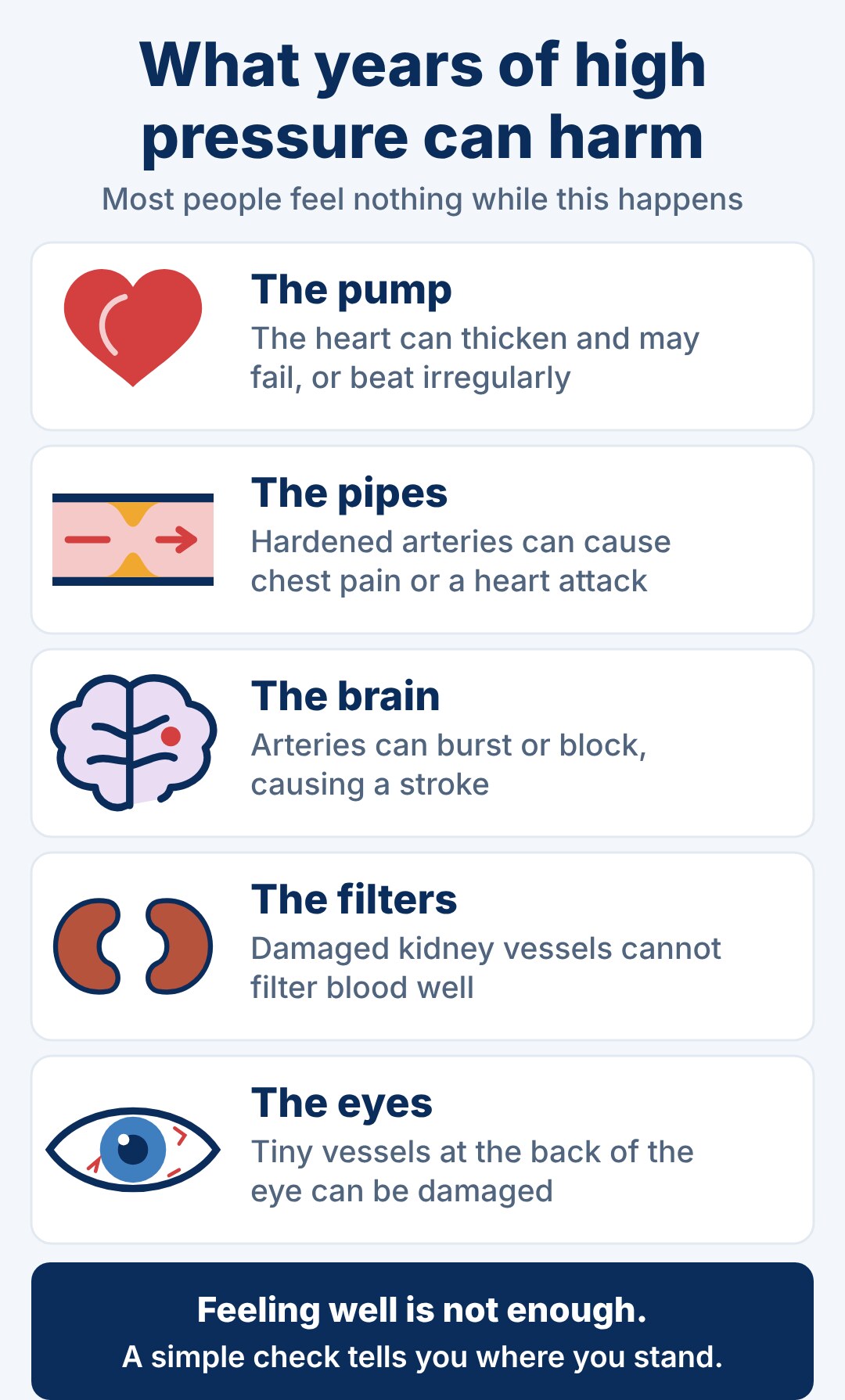
- The pump: The heart can thicken and may fail, or develop an irregular beat.
- The pipes: Arteries can harden, reducing blood flow and leading to chest pain or a heart attack.
- The brain: Arteries can burst or become blocked, causing a stroke. High blood pressure is also linked to memory problems and vascular dementia.
- The filters: Damaged kidney blood vessels cannot filter blood well, which can lead to kidney failure.
- The eyes: Tiny blood vessels at the back of the eye can be damaged.
An example story: Raj is 45 and feels fine. A pharmacy check shows 152/96. His doctor repeats it, and his home average over 7 days is 146/92, which confirms high blood pressure. His tests show no organ damage and his heart risk is low, so they agree on more walking, less salt and a review. He may still need medicine if his pressure stays high. Raj is made up to show how this can work. He is not a real patient.
How is blood pressure checked?
NICE advises a check at least every 5 years if you do not have high blood pressure, and more often if your reading is raised but below 140/90. European guidance suggests a check at least every 3 years under 40, and every year from 40.
There are three main ways to measure it:
- Clinic reading: A doctor, nurse or pharmacist measures it while you sit quietly.
- Home monitoring: You take two readings, at least 1 minute apart, in the morning and evening for at least 4 days, ideally 7. Ignore the first day and average the rest.
- 24-hour monitoring: You wear a small device that takes regular readings during the day.
Clinic readings alone can mislead, as some people’s blood pressure rises only in a clinic. Home readings usually run about 5 points lower than clinic readings, which is why the home limit is 135/85. Use a validated machine. If your pulse is irregular, automatic machines may not be accurate, so tell your doctor. Checking at home? See how to check your blood pressure at home and use our home blood pressure average calculator.
What to expect from your doctor
If your reading is high, your doctor will usually:
- Repeat it, and check both arms when diagnosing you.
- Confirm it with 24-hour monitoring, or home monitoring if that does not suit you.
- Check for damage and other risks with urine and blood tests, an eye check and a heart tracing (ECG).
- Estimate your risk of heart disease and stroke.
- Discuss lifestyle changes and whether you need medicine.
- Review you regularly.
If you are under 40, book an appointment soon. Your doctor may ask a specialist to look for a hidden cause.
When should you seek urgent help?
Call 999 or your local emergency number if you have a high reading with:
- Chest pain or severe breathlessness
- Weakness or numbness, a drooping face or difficulty speaking
- Sudden loss of vision
- A sudden severe headache or new confusion
Get urgent help the same day by speaking to your doctor or calling NHS 111 if your reading is 180/120 or above, after waiting 5 minutes and measuring again, and you have:
- Blurred vision or new floaters
- Blood in your urine
- New swelling of your legs, or passing much less urine
Also get help the same day if you have sudden attacks of headache, a pounding heartbeat, sweating and looking pale.
If your reading is 180/120 or above and you feel well, measure again after 5 minutes and speak to your doctor the same day. NICE advises tests for organ damage as soon as possible. If no damage is found, your reading should be confirmed within 7 days.
If you are pregnant or have recently given birth, a high reading or symptoms of pre-eclampsia, such as a severe headache or blurred vision, need urgent medical help. Speak to your doctor or call NHS 111 straight away.
How to prevent high blood pressure and bring it down
These habits are especially important if you want to avoid developing high blood pressure. If you already have it, they work alongside your treatment and can improve its effect. Start early if you can, as healthy habits begin in childhood.
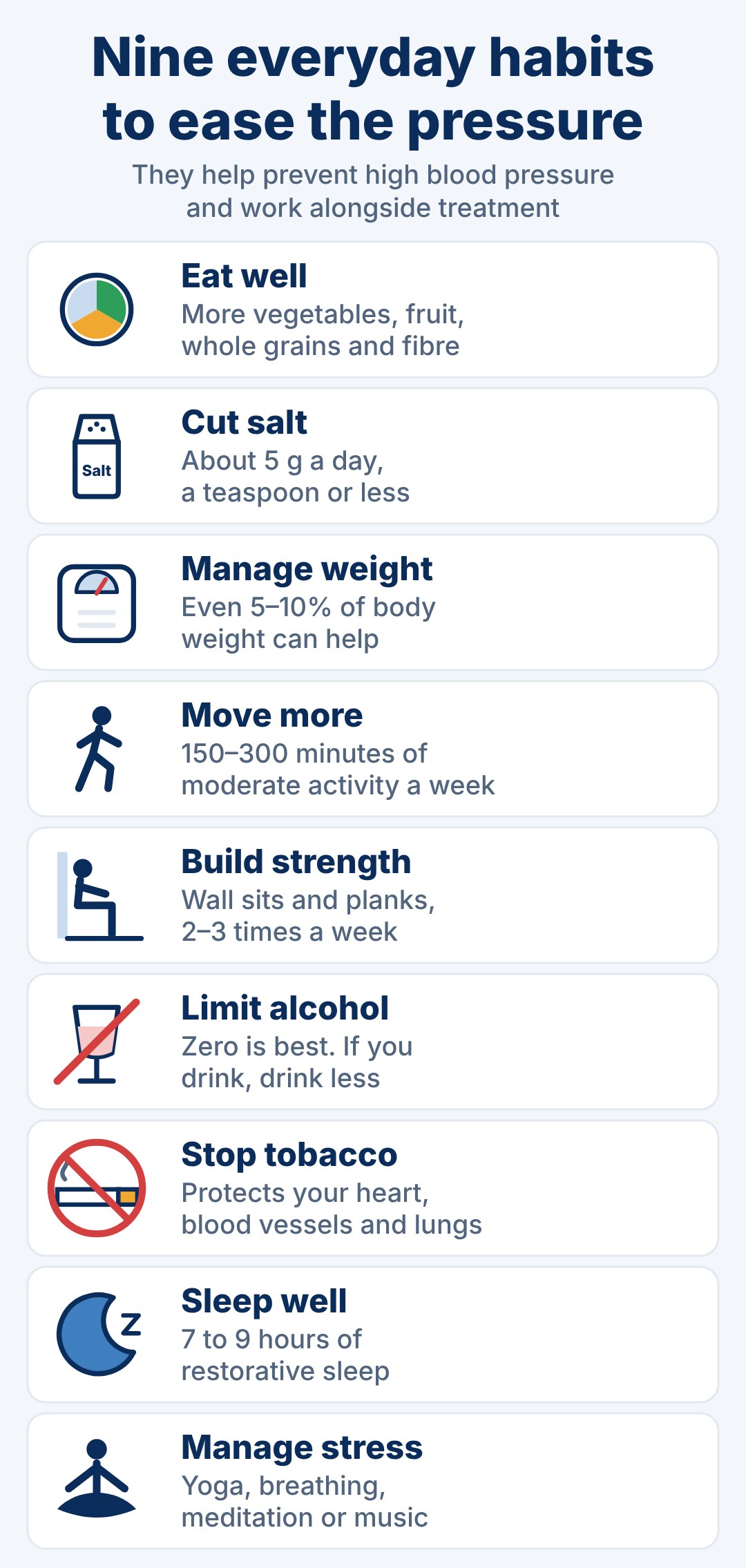
1. Eat well
What to do: Follow the DASH eating pattern or a Mediterranean-style diet. Eat more vegetables, fruit, whole grains, beans, lentils, nuts and fish. Eat less saturated fat, red meat and sugar, and aim for 25–29 g or more of fibre a day. NICE does not advise calcium, magnesium or potassium supplements to lower blood pressure.
Why it helps: DASH is the most effective eating pattern for preventing high blood pressure and lowering it. In controlled studies, it lowered blood pressure by about 11/6 mmHg. Fruit and vegetables provide potassium, which helps the kidneys remove sodium and relaxes blood vessels. Gut bacteria also ferment fibre into substances that can help blood vessels widen.
2. Cut salt
What to do: Aim for about 5 g of salt a day, which is about a teaspoon or less. Check food labels, and reduce the salt you add when cooking.
Why it helps: Less salt can reduce the amount of fluid in the pipes, so the heart pumps less blood with each beat and the pressure falls. Cutting sodium lowers blood pressure by about 7/3 mmHg in people with hypertension and 3/2 mmHg in people without it. In wealthier countries, about 80% of salt comes from processed food. In many lower-income countries, most is added during cooking or at the table.
3. Manage your weight
What to do: If you are overweight, aim for gradual weight loss that you can keep up. Even 5–10% of your body weight can improve blood pressure. Keep an eye on your waist as well as your weight.
Why it helps: Weight loss calms overactive nerves, helps insulin work better and helps the kidneys handle sodium. On average, each 1 kg lost lowers blood pressure by about 1/1 mmHg. Some people may need less medicine. Keeping the weight off is the hard part, so choose changes you can live with.
4. Move more
What to do: Aim for 150–300 minutes of moderate activity a week, or 75–150 minutes of vigorous activity. Sit less and walk more where you can. Any regular activity helps, and it is fine to start small.
Why it helps: Regular exercise keeps the inner lining of blood vessels healthier and makes arteries more flexible, so blood flows with less resistance. It also improves fitness and reduces inflammation. In people with hypertension, regular aerobic exercise can lower blood pressure by up to 7–8/4–5 mmHg. Exercise works on many body systems together, and adding it to medicine lowers blood pressure more than medicine alone.
5. Build strength
What to do: Add strength exercise 2–3 times a week. Isometric exercises, such as wall sits, planks and hand-grip holds, are a good choice. Try three sets of 1–2 minutes at low to moderate effort.
Why it helps: Isometric training is one of the most effective exercises for lowering blood pressure, with falls of about 8/4 mmHg. Keep aerobic exercise as your base and add these holds to it.
6. Limit alcohol
What to do: Zero alcohol is best for your heart. If you do not drink, do not start. If you do, drink less and avoid binge drinking.
Why it helps: Alcohol stimulates the “fight or flight” nerves and a hormone system that raises blood pressure. Cutting down helps most in heavy drinkers. Those who had six or more drinks a day saw falls of about 5.5/4 mmHg.
7. Stop tobacco
What to do: Stop all tobacco, and avoid e-cigarettes and second-hand smoke. Ask for support, and plan ahead to avoid weight gain after quitting.
Why it helps: Smoking raises blood pressure for a short time and speeds up artery damage. Stopping may not lower your usual blood pressure much, but it is one of the best things you can do for your heart, blood vessels and lungs.
8. Sleep well
What to do: Aim for 7 to 9 hours of restorative sleep a night. Keep regular sleep times, get daylight and exercise during the day, and avoid caffeine, alcohol, cigarettes and heavy food close to bedtime. Keep naps under 30 minutes. If you snore loudly or feel sleepy during the day, tell your doctor.
Why it helps: Blood pressure normally falls during sleep. Short or poor sleep can overactivate the nerves that raise blood pressure and reduce this night-time fall. Shift work and sleep apnoea can add to the risk.
9. Manage stress
What to do: Choose something you can keep up, such as meditation, yoga, breathing exercises or music.
Why it helps: Stress can activate the nerves and hormones that raise blood pressure, and it can lead to poor eating, drinking or smoking. These methods may help, but the evidence is weaker than for food, salt and exercise. NICE no longer has a recommendation on relaxation therapies.
Does exercise raise blood pressure?
- Yes, for a short time while you are exercising. It can then fall for a while afterwards, and regular training lowers your resting pressure. If your blood pressure is very high or you have a heart condition, speak to your doctor before hard exercise.
Thinking of using a low-sodium salt?
- Potassium-enriched salt can lower blood pressure and stroke risk in some people. NICE says it should not be used by older people, pregnant women, people with diabetes or kidney disease, or people taking some blood pressure medicines. Ask your doctor or pharmacist first.
If you have a South Asian background
South Asians in the UK are at higher risk of developing high blood pressure or type 2 diabetes, so regular checks matter even if you feel fit.
Salt is often the hidden problem. In one survey in India, people ate about 8.6 to 9.5 g of salt a day, well above the 5 g limit. Small changes add up:
- Go easy on pickles, papads, chutneys, sauces and ketchup.
- Do not add salt to rice, or to dough for chapati, poori or paratha.
- Do not sprinkle salt on salad, cut fruit, cooked vegetables or curd.
- Swap salted namkeens and snacks for fresh fruit and vegetables.
- Reduce the salt you use in cooking gradually.
Treatment: lifestyle and medicine together
Lifestyle is the foundation of treatment, but many people still need medicine. The two work as a team, and one does not replace the other.
The main medicines are ACE inhibitors, angiotensin receptor blockers (ARBs), calcium channel blockers and diuretics. In the UK, NICE advises starting with one medicine, then adding more in steps if needed. European guidance prefers starting most people on low doses of two medicines together. Treatment is usually long-term.
When is medicine advised?
- Clinic reading 160/100 or above (home average 150/95 or above): NICE advises offering medicine at any age.
- Clinic reading 140/90 to 159/99 (home average 135/85 to 149/94): if you are under 80, your doctor will discuss medicine if you have organ damage, heart or circulation disease, kidney disease, diabetes, or a 10-year heart risk of 10% or more. If you are under 60 with a lower risk, or over 80 with a clinic reading above 150/90, your doctor may still consider it.
What is the goal?
- Under 80: below 140/90 in clinic, or a home average below 135/85.
- 80 and over: below 150/90 in clinic, or a home average below 145/85.
- Some people with kidney disease or type 1 diabetes: below 130/80 in clinic.
Frequently asked questions
Does one high reading mean I have high blood pressure?
No, unless it is very high. Blood pressure changes through the day, so we advise home monitoring for at least 4 days, ideally 7, and working out the average. Use our calculator to work out your average.
Why should I not stop my medicine suddenly?
Your medicine may be the reason your blood pressure is normal. Stopping clonidine suddenly can cause a dangerous rise in blood pressure, and stopping a beta-blocker suddenly can make your condition worse. With any blood pressure medicine, not taking it as prescribed leaves you unprotected, and people who do this have a much higher risk of stroke. If you want to stop or reduce a medicine, speak to your doctor first. If lifestyle changes work well, your doctor may be able to reduce it safely.
How often should my blood pressure be reviewed?
After starting treatment, you may be seen every 1 to 3 months until your blood pressure is controlled. Once it is stable, NICE advises a review at least once a year. Some people are seen more often.
What if I get side effects from many medicines?
Still speak to your doctor. Do not give up on treatment. Some people do not tolerate several types of medicine, which is called multiple drug intolerance. Your doctor may try a low-dose combination of medicines, which may reduce side effects and make treatment easier to continue. Even if the ideal target is not possible, the aim is to get your blood pressure as low as you can safely tolerate.
Does coffee cause high blood pressure?
Ordinary coffee does not seem to increase the risk, although NICE advises against drinking too much caffeine. Energy drinks can raise blood pressure.
Why do I need tests if I feel well?
High blood pressure can affect your heart, kidneys and eyes before you notice anything. Tests also look for other risks, such as diabetes and high cholesterol.
Key points
- Most people with high blood pressure feel well, so get checked.
- Know the emergency warning signs.
- Healthy habits help prevent high blood pressure and support treatment.
- Never stop your medicine suddenly without speaking to your doctor.
Your heart and blood vessels work quietly every day, so it is easy to forget them. High blood pressure can cost lives while people feel perfectly well, and most of those deaths can be prevented. A simple check tells you where you stand, and there is plenty we can do to bring the pressure down.
What’s next? Next, we look at blood pressure medicines, what they do and what to expect: Blood Pressure Medicines: What They Do and What to Expect.
References
- WHO. Uncontrolled high blood pressure puts over a billion people at risk. 2025.
- WHO. Hypertension fact sheet. 2025.
- NICE. Hypertension in adults (NG136). Updated February 2026.
- McEvoy JW, et al. 2024 ESC hypertension guidelines. Eur Heart J 2024;45:3912–4018.
- Charchar FJ, et al. Lifestyle management of hypertension. J Hypertens 2024;42:23–49.
- Shah SN, et al. Indian Guidelines on Hypertension-IV. J Hum Hypertens 2020;34:745–58.
- Beevers G, et al. The pathophysiology of hypertension. BMJ 2001;322:912–6.
- Han B, et al. Lifestyle interventions for hypertension. Ewha Med J 2025;48:e56.
- Edwards JJ, et al. Exercise training and resting blood pressure. Br J Sports Med 2023;57:1317.
- Herttua K, et al. Adherence before stroke. Eur Heart J 2013;34:2933–9.
- Rusinek J, et al. Multiple drug intolerance and hypertension. J Clin Med 2025;14:6218.
- NHS. Pre-eclampsia symptoms.
- NHS Medicines. Clonidine; carvedilol.
- British Heart Foundation. Ethnicity and heart disease.
- Johnson C, et al. Mean dietary salt intake in India. J Am Heart Assoc 2017;6:e004547.
- Eat Right India. Reduce salt.