
Written by Dr Nandan Jha, MBBS, MRCEM, MRCGP · November 2026
Has your doctor or nurse asked you to check your blood pressure at home for a week? Enter your readings here and the calculator works out your home average the way UK, European and Indian guidelines do, then makes a report you can print or send to your doctor.1,3,4
New to home checks? Read our step-by-step guide first: How to Check Blood Pressure at Home Correctly.
Feeling unwell right now? See warning signsBefore you start
- Use a validated upper-arm monitor with a cuff that fits your arm.1,3,4
- Morning: about 30 minutes after waking, after the toilet, before tea, coffee, breakfast or tablets. Evening: 30 minutes to 1 hour before bed.3,4
- Sit for 5 minutes, back supported, feet flat, legs uncrossed, arm resting on a table with the cuff at heart level. Don’t talk.1,3,4
- Take 2 readings, 1–2 minutes apart, and enter both. Don’t keep only the lowest.1,3,4
- Checking for high blood pressure: 4–7 days. Already on treatment: 3–5 days before your review.1,3,4
Pictures and full details: cuff size · how to sit and when to measure
Enter your readings
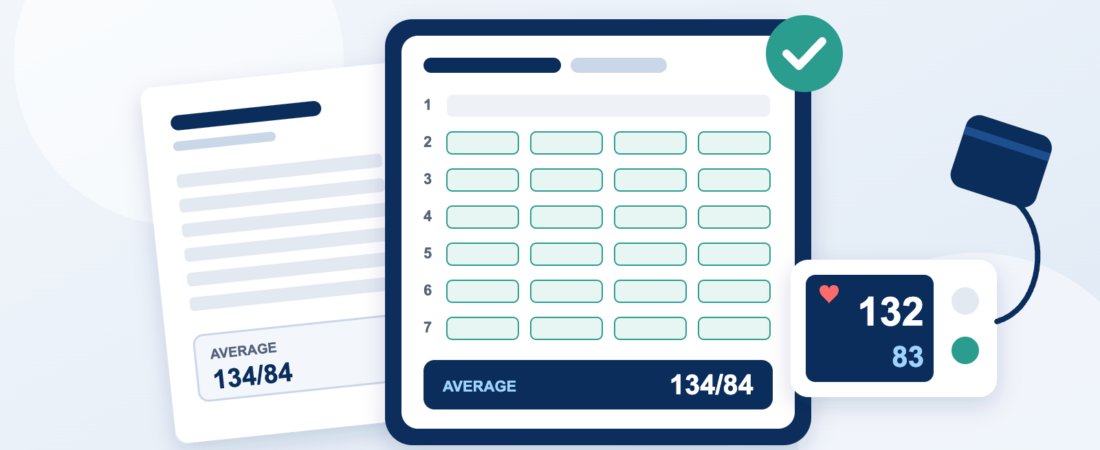
Day 1 is a practice day and is not counted. The calculator averages all your other readings: top numbers together and bottom numbers together.1,3,4 If you are on treatment, choose the Monitoring tab and your situation; the target fills in for you, and you can change it to the one your doctor gave you.
Type the top number (systolic) in the first box and the bottom number (diastolic) in the second. Your readings are kept only in this browser on this device; nothing is sent to us. Your name is never saved.
What does my home average mean?
| Home average | Meaning | What to do |
|---|---|---|
| below 130/80 | Normal | Keep healthy habits; recheck every year |
| 130–134 / 80–84 | High-normal | Lifestyle changes; check more often |
| 135–149 / 85–94 | High blood pressure, stage 1 | Book a routine appointment |
| 150/95 or more | High blood pressure, stage 2 | See your doctor soon |
If your top and bottom numbers fall in different rows, go by the higher row. Based on UK, European and Indian guidance; American guidance calls a home average of 130/80 or more high.1,2,3,4 If you have diabetes or kidney disease, see targets for diabetes and kidney disease.
When to get help
- chest pain, or sudden severe back pain
- breathlessness
- severe headache, new confusion, or a change in your vision
- weakness or numbness, or difficulty speaking
- very little urine, or blood in your urine
- collapse
Stroke signs and collapse always need an ambulance, whatever the reading.
Frequently asked questions
How do I calculate my average home blood pressure?
Leave out Day 1. Add up all the remaining top numbers and divide by how many there are, then do the same for the bottom numbers. With 2 readings morning and evening for 7 days, that is 24 readings from Day 2 to Day 7.1,3,4
Why is Day 1 left out?
Readings on the first day are often higher while you get used to the machine and the routine, so guidelines leave Day 1 out of the average.1,3,4
Should I use the lower of my two readings?
No. At home, write down both readings and average all of them. Picking the lower one only applies to readings taken by a doctor or nurse in the clinic, and doing it at home makes your average look lower than it really is.1,3,4
How many readings do I need?
For checking whether you have high blood pressure, use at least 4 days, ideally 7. For checking treatment, use 3 to 5 days. At least 12 readings after Day 1 is a good minimum.1,3,4
Is my name or are my readings saved?
Your name is never saved. Your readings stay only in this browser on this device so you can come back to them, and nothing is sent to us. Press Clear table to remove them.
Got your average? Find out what it means, when it is urgent and what you can do in our guide to high blood pressure.
What’s next? Make sure your readings are accurate: learn which machine to use, how to fit the cuff and how to sit.